
Retail and eCommerce Case study
Direct selling storefront and distributor back office
Direct selling website for a US supplement brand: a replicated storefront and a distributor back office with guest checkout, enrollment, auto-orders and marketing automation.
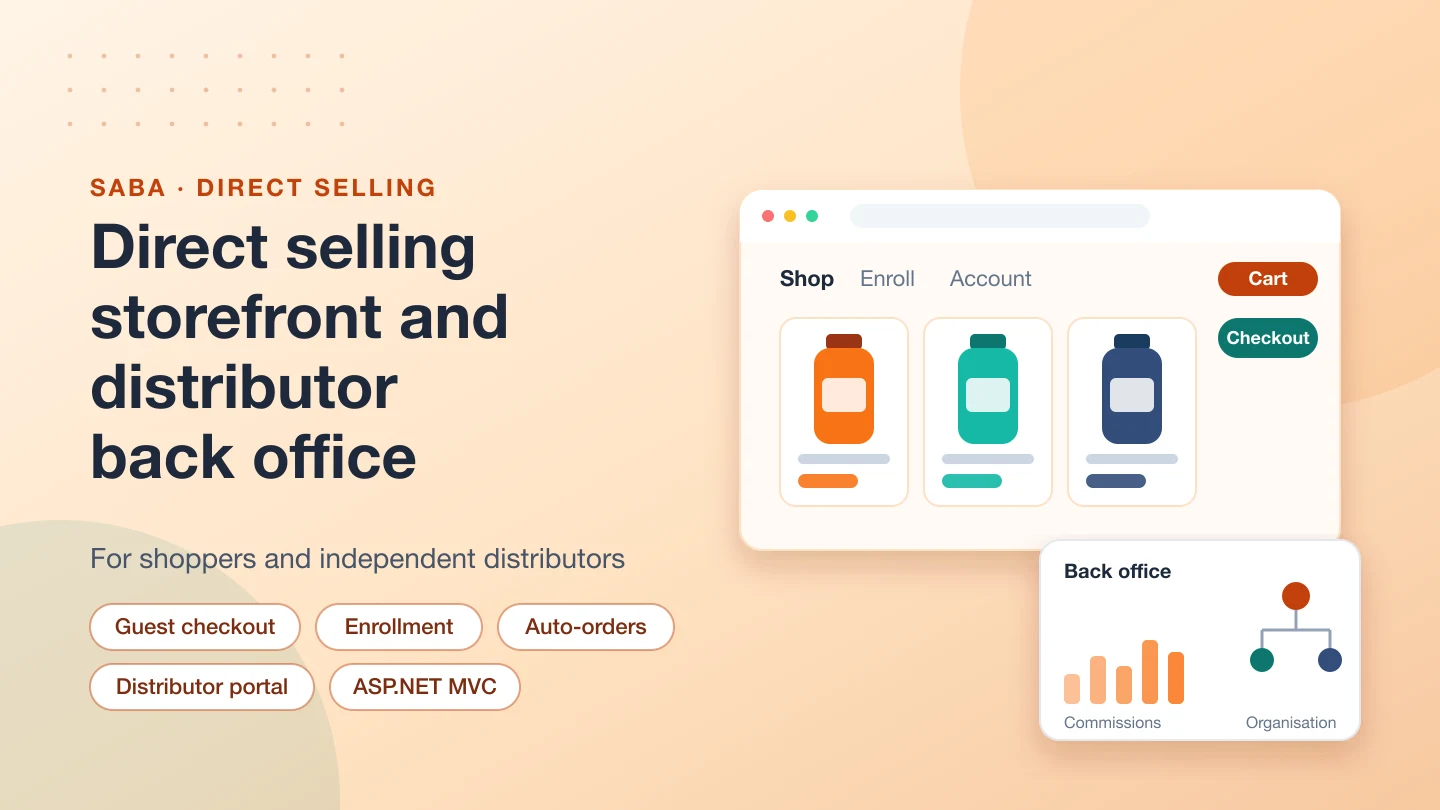
- Client
- Saba
- Service
- Web apps, eCommerce, Integrations
- Years
- 2025–2026
- Stack
- Azure App Service, ASP.NET MVC, .NET Framework, Redis and 10 more
- Platforms
- Web
Overview
Saba sells nutritional supplements through shoppers and independent distributors. Two ASP.NET MVC sites share one code library and talk to the brand's direct-selling platform: a public replicated storefront for shopping, enrollment and checkout, and a back office where distributors follow their organisation, commissions, orders and events. We extended both sites, tuned page speed and checkout, wired up marketing automation, and ship every change through GitHub Actions to several Azure environments.
The challenge
Both sites rely on one back-end platform of record, so every page has to respect its API limits. Checkout must survive failures and double submits, supplement content needs careful wording, and releases go to several environments.
What we built
- Product, landing and content pages with responsive layouts, image optimisation and caching for faster shopping pages
- Cart, shipping options, promo codes and an express guest checkout with recovery routes, receipts and retry protection against double orders
- Enrollment flow with enroller selection and recovery, plus a customer account area for addresses, saved payment methods, order history and recurring orders
- A distributor back office with dashboard, organisation and party views, commissions, orders, events, resources and company news
- Marketing hooks for email and SMS sign-up, consent and checkout events, and a WordPress-backed blog
- A shared library for models, services, caching and adapters used by both sites
- GitHub Actions workflows that build and publish each site to Azure App Service slots
- Regression tests for checkout, and a written analysis of the platform's API quota with fixes proposed
- An AI customer assistant inside the storefront (see the separate AI case)
How a system like this fits together
Reference architecture: replicated storefront and distributor back office
Simplified reference architecture, not a client schematic.
- A shopper browses the replicated storefront and adds products to the cart, applying promo codes if they have them. Distributors use the back office, which shares the same code library and the same platform.
- Checkout loads and the storefront calculates the order through the direct-selling platform, the system of record for customers, orders and commissions.
- Card details are tokenized by a card tokenization service instead of being stored by the site.
- The order is submitted and processed in the platform; a receipt and a retry identity guard against double submits.
- The storefront sends marketing events to Klaviyo and Brevo for email, and handles SMS sign-up. Blog content comes from WordPress.
Technology used
| Layer | Choice | Purpose |
|---|---|---|
| Hosting | Azure App Service | several environments through deployment slots |
| Web | ASP.NET MVC 5, Razor, .NET Framework | storefront and distributor back office |
| Content | WordPress | blog content |
| Data | Entity Framework, Dapper, Redis | local data and caching in front of the platform API |
| Marketing | Klaviyo, Brevo | email, SMS sign-up and checkout events |
| Delivery | GitHub Actions | build and release workflows |
| Front end | jQuery, Kendo UI grids | interactive pages and data grids |
What happened next
- Delivered
The work described above was delivered to the client.
- Operational facts
- Our work on this project spanned 2025–2026.
Could this be your project?
- You need a web application with user accounts, admin tools and reporting. Website and web app development
- You run a retail brand or an online store and need custom ordering, checkout, catalogue or customer-loyalty rules. eCommerce solutions
- You work in retail and ecommerce and want a team that has built for it before. Retail and eCommerce work
Questions about this project
How long did this project take?
Our work on it ran from 2025 to 2026.
What technology was used?
Azure App Service, ASP.NET MVC, .NET Framework, Redis, WordPress, Razor, Entity Framework, Dapper, Kendo UI, Serilog, Klaviyo, Brevo, GitHub Actions, jQuery.
Similar work

Also .NET and content management systems, same industry
Top Tier Editing: quote calculator and order platform
A .NET Blazor quote calculator, order and checkout flow and back office for Top Tier Editing, an editing service: instant prices from admin-set rules, document upload with word count, Stripe and PayPal payments and scheduled emails.
Also .NET and content management systems, also a web app
Freight bidding marketplace
An ASP.NET web marketplace where shippers post freight loads and carriers bid, with plans and free trials, freight alarms, card and ACH payments, mileage lookup and a SOAP API to external logistics systems, on Azure.
Also .NET and content management systems, also a web app
TheHopeLine: crisis-support community platform
A long-running ASP.NET website, agent CRM and mobile app for a youth crisis-support organisation: topic pages, live chat, prayer requests, reports and reminders.