
Fintech and payments Case study
Bank reconciliation workflows on self-hosted n8n
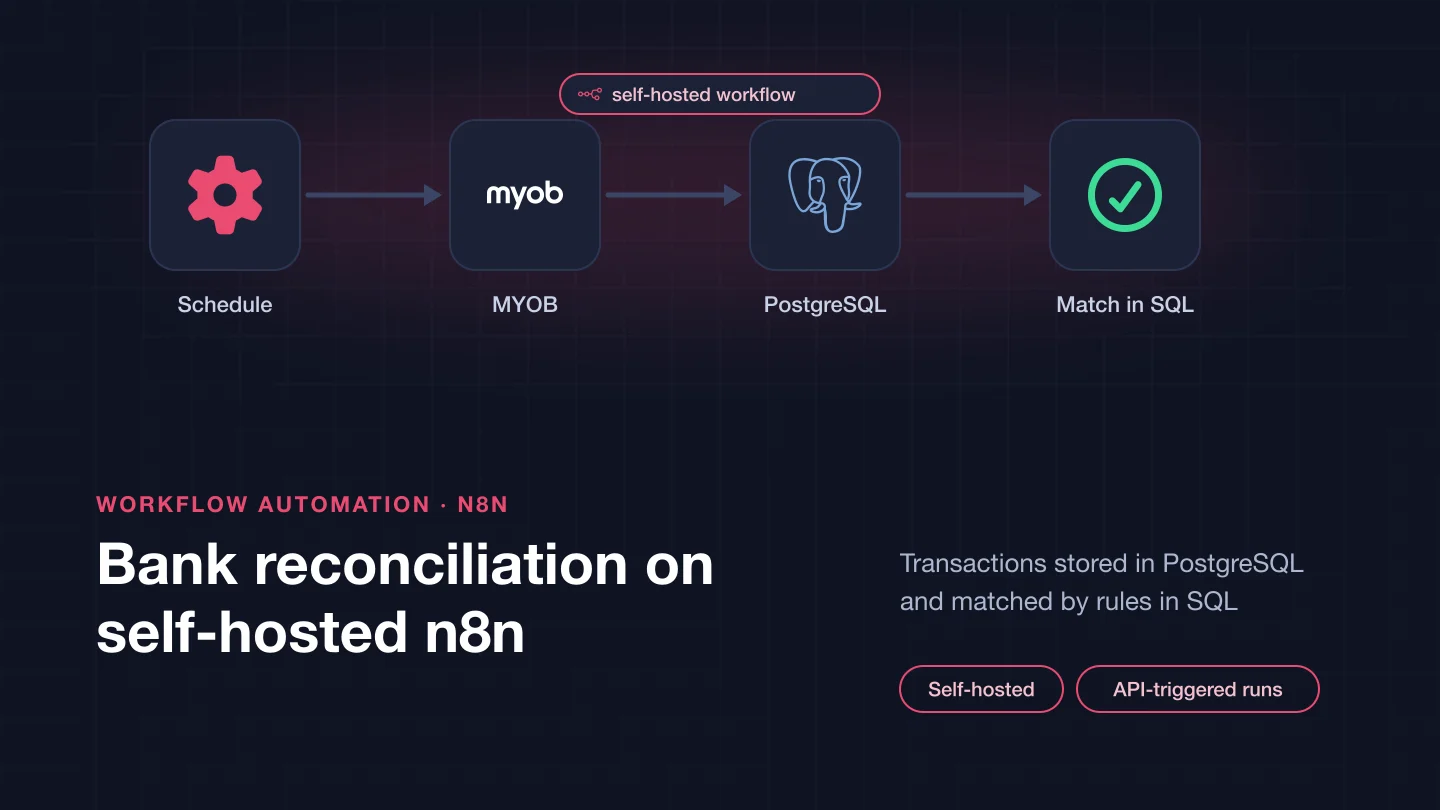
A reconciliation service run by self-hosted n8n: transactions from MYOB and a second source are stored in PostgreSQL and matched in SQL, started through an API endpoint.
- Client
- Finance operations team
- Service
- Integrations
- Years
- 2025–2026
- Stack
- PostgreSQL, n8n, MYOB API, REST APIs
Client details are private, so this study describes the client by type.
Overview
A finance team reconciled bank transactions by hand. We designed a reconciliation service around self-hosted n8n: transaction data is extracted from MYOB Advanced and from a second system, stored in PostgreSQL, and matched by rules written in SQL. n8n runs the job by calling an API endpoint in our service, so the matching logic lives in code that can be read and tested, and the workflow tool only orchestrates it.
The challenge
Pulling data from an accounting platform and a second system that each have their own access rules, and keeping the matching logic testable instead of hiding it inside workflow steps.
What we built
- The architecture for the first milestone, with a hosting platform recommended for self-hosted n8n
- Research on the MYOB sandbox and REST APIs, and a local MYOB Advanced setup for development
- Access to a second data source through its API and checks of credentials and network access
- A PostgreSQL layer that stores the extracted transactions
- Reconciliation rules written in SQL that match transactions
- An API endpoint that starts a reconciliation run, and n8n workflows that call it
Technology used
| Layer | Choice | Purpose |
|---|---|---|
| Data | PostgreSQL | stored transactions and matches |
| Orchestration | n8n | runs the reconciliation, self-hosted |
| Sources | MYOB API | transaction data, with a second system read through its own API |
| Logic | SQL | matching rules behind an API endpoint, readable and testable |
What happened next
- Delivered
The work described above was delivered to the client.
- Operational facts
- Our work on this project spanned 2025–2026.
Could this be your project?
- Your product has to connect to payment, accounting, messaging or other third-party systems.
- You want a realistic written estimate for something of this kind, based on comparable work.
- You work in fintech and payments and want a team that has built for it before. Fintech and payments work
Questions about this project
How long did this project take?
Our work on it ran from 2025 to 2026.
What technology was used?
PostgreSQL, n8n, MYOB API, REST APIs.
Similar work
Also PostgreSQL, same industry
AutoAccount: financial management and accounting platform
A React and FastAPI accounting platform for multi-location repair shops: bank and Tekmetric data, AP/AR, bill scheduling, payroll and ledger entries, dashboards and reports.
Also PostgreSQL, same industry
Reactor: AI assistant and Web3 data back end
A Node.js back end for Reactor, an AI chat assistant with Web3 tools: streaming chat and voice, a keyed language-model API for businesses, and a crypto service for token audits, swaps and rewards.
Also PostgreSQL, same industry
A .NET trading engine, API and Next.js control console for Rainbow Capital that runs configurable US equity options strategies under per-underlyer risk limits, with daily profit and loss reports to Slack.