Built with Azure OpenAI
Ecommerce AI chatbot on Azure OpenAI
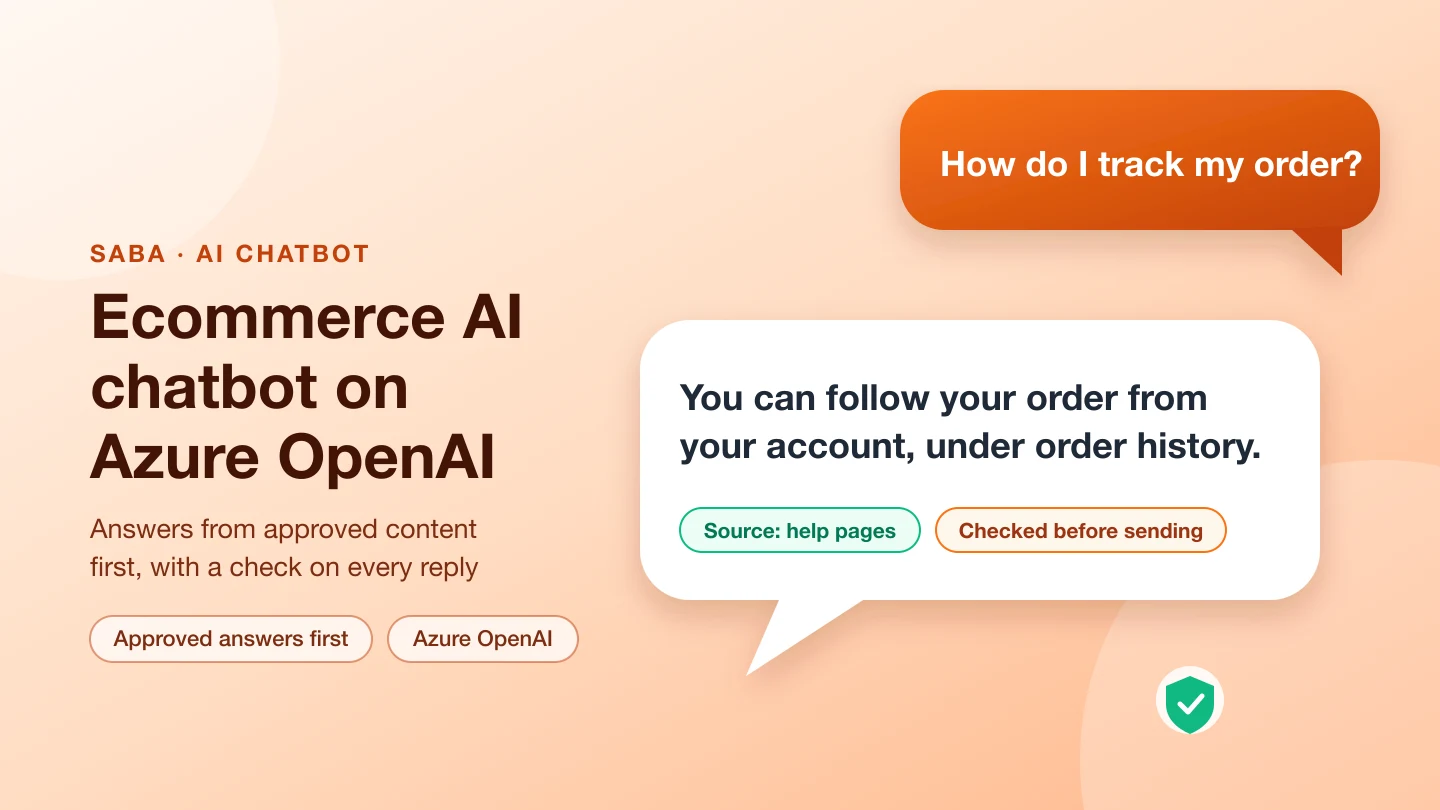
Ecommerce AI chatbot for a supplement store: approved answers first, Azure OpenAI only from retrieved passages (RAG), and guards for health claims, prices and unsafe topics.


Azure OpenAI suits teams that already run on Azure or must keep AI inside it (for the platform itself, see Azure development):
Plain OpenAI is often simpler. Plan around these before you commit:
You create a resource in Microsoft Foundry and deploy a model to it. Your code calls the deployment by its name, which can differ from the model name. The deployment type sets where prompts are processed: Global types may use any Azure region, Data Zone types stay within the US, EU or Asia Pacific zone, and Standard types stay within your Azure geography. Data stored at rest stays in your chosen geography in every case. Microsoft says prompts and completions are not available to OpenAI and are not used to train the models. Content filters check prompts and completions for hate, sexual content, violence and self-harm at levels you can set, and optional prompt shields flag jailbreak attempts and instructions hidden in documents. The v1 API works with the OpenAI client libraries with minimal code changes and no monthly api-version.
finish_reason set to content_filter. We handle both and show the user a clear message. If the filter service is unavailable, the request completes unfiltered with an error noted in the response, so we check for that too.Built with Azure OpenAI
Ecommerce AI chatbot for a supplement store: approved answers first, Azure OpenAI only from retrieved passages (RAG), and guards for health claims, prices and unsafe topics.
It runs OpenAI models, but Microsoft hosts them in Azure and they do not interact with services run by OpenAI. You deploy a model to your own resource and call it by deployment name. The v1 API lets the OpenAI client libraries call it with minimal code changes.
Data stored at rest stays in your chosen Azure geography. For processing, Data Zone deployments stay within the US, EU or Asia Pacific zone, and Standard deployments stay within your geography. Global deployments may process prompts in any Azure region.
Every deployment has default filters, and you can make them stricter or more lenient. Turning filtering off or to annotate only for completions requires approval for modified content filters from Microsoft.
When you do not run on Azure and have no rule that requires it. The OpenAI API needs no Azure subscription, resource, deployment or quota request, and new models reach it without waiting for a regional deployment.
There are three ways, on the same terms:
Whichever you choose, we sign an NDA before work starts, you own the code we write, and every change is reviewed in your repository.
Yes. For a dedicated team you meet the developers in an online call and interview them before they join your project.
Tell us your data rules, the content the assistant should use and who will read the answers. We will say what to set up first and whether plain OpenAI would be simpler.
Tell us what you need built, fixed or improved. We come back with questions, a suggested approach and an estimate.